Arabic SEO services: How to increase Google traffic across the Middle East?

Key takeaways: Arabic SEO services at a glance
|
You may already have a strong English website. But if you serve patients, clients, or customers across the Middle East, many of them search in Arabic. If your pages don’t answer them in Arabic, you can lose visits you never knew you missed.
That’s where Arabic SEO services come in. This blog explains what they include, how they work, and how you can use them to grow Google traffic across the region. You’ll also see how to prepare your content for AI tools like ChatGPT, Gemini, Claude, and Perplexity.
What are Arabic SEO services?
Arabic SEO services help your website appear in relevant Arabic search results. For healthcare businesses, this means making it easier for patients to find information about doctors, clinics, medical specialities, and treatments in Arabic.
It takes more than translating your English pages. You need to know how Arabic-speaking audiences search, the phrases they use, and the questions they ask before choosing a healthcare provider.
For example, a clinic in Dubai may have an English page about dermatology services. An Arabic-speaking visitor may search using a different phrase or ask a question about a specific skin concern. A well-planned Arabic SEO strategy helps the clinic create content that responds to those searches.
A complete Arabic SEO strategy may include:
- Arabic keyword research based on search intent
- Website copy written or reviewed by native Arabic speakers
- Arabic content creation and localization
- Technical SEO for Arabic and English pages
- Local SEO for clinics and hospitals
- Business listings and online review management
- Content optimization for Google Search and AI-powered search platforms
SEO Arabic goes beyond translating your website. It means using the right search terms and creating useful content that Arabic-speaking patients can understand and relate to.
Why does your healthcare business need Arabic SEO across the Middle East?
Arabic speakers are a large online audience. Arabic content makes up a small share of the web compared with the number of people who speak the language.
For your healthcare business, the point is simple. When people look for a clinic, a service, or health information in Arabic, they want pages written for them.
Here’s what Arabic SEO can do for you:
- Reach Arabic-speaking patients: Create content for people who prefer to search and read in Arabic.
- Improve service visibility: Make it easier for patients to find your specialities, treatments, doctors, and appointment details.
- Build patient confidence: Explain your services, doctors’ qualifications, and how to book an appointment in simple Arabic.
- Match real behavior: In the UAE, many people switch between Arabic and English during one search journey. Some types of Arabic words in Latin letters.
- Support your whole site: Arabic pages can sit next to your English pages and work together.
- Strengthen your digital presence: Connect Arabic SEO with English SEO, social media, and other relevant marketing activities.
SEO takes time to build visibility, and results depend on factors such as competition, website quality, and content. It cannot guarantee patient bookings, and healthcare decisions should always be based on individual needs and appropriate medical advice.
Arabic keyword research: Start with how people search
Arabic keyword research is the basis of every good plan. Don’t copy your English list and translate it word-for-word. Arabic has formal and spoken forms, and the Gulf region uses its own phrases.
Follow these steps:
- Identify your main services: List the medical specialities, treatments, diagnostic services, and locations you want to target.
- Research Arabic search terms: Explore how Arabic-speaking audiences describe these services, including common questions and alternative phrases.
- Use Google search suggestions: Check Google Autocomplete and “People also ask” results for relevant Arabic queries in your target market.
- Include spelling variations: Check Arabic searches, English terms, and Arabic words typed in Latin letters.
- Group keywords by intent: Separate searches for health information from those aimed at finding a clinic, contacting a provider, or booking an appointment.
- Match keywords to pages: Assign each keyword group to the right page to avoid overlap between pages targeting similar searches.
- Review search performance: Use Google Search Console and keyword tools to track clicks, impressions, and search queries.
- Update your keyword list: Remove irrelevant terms, identify content gaps, and adjust your targets based on search data and audience needs.
The keywords Arabic searchers use can vary by country. A phrase common in Saudi Arabia may sound different in the UAE. Test before you publish.

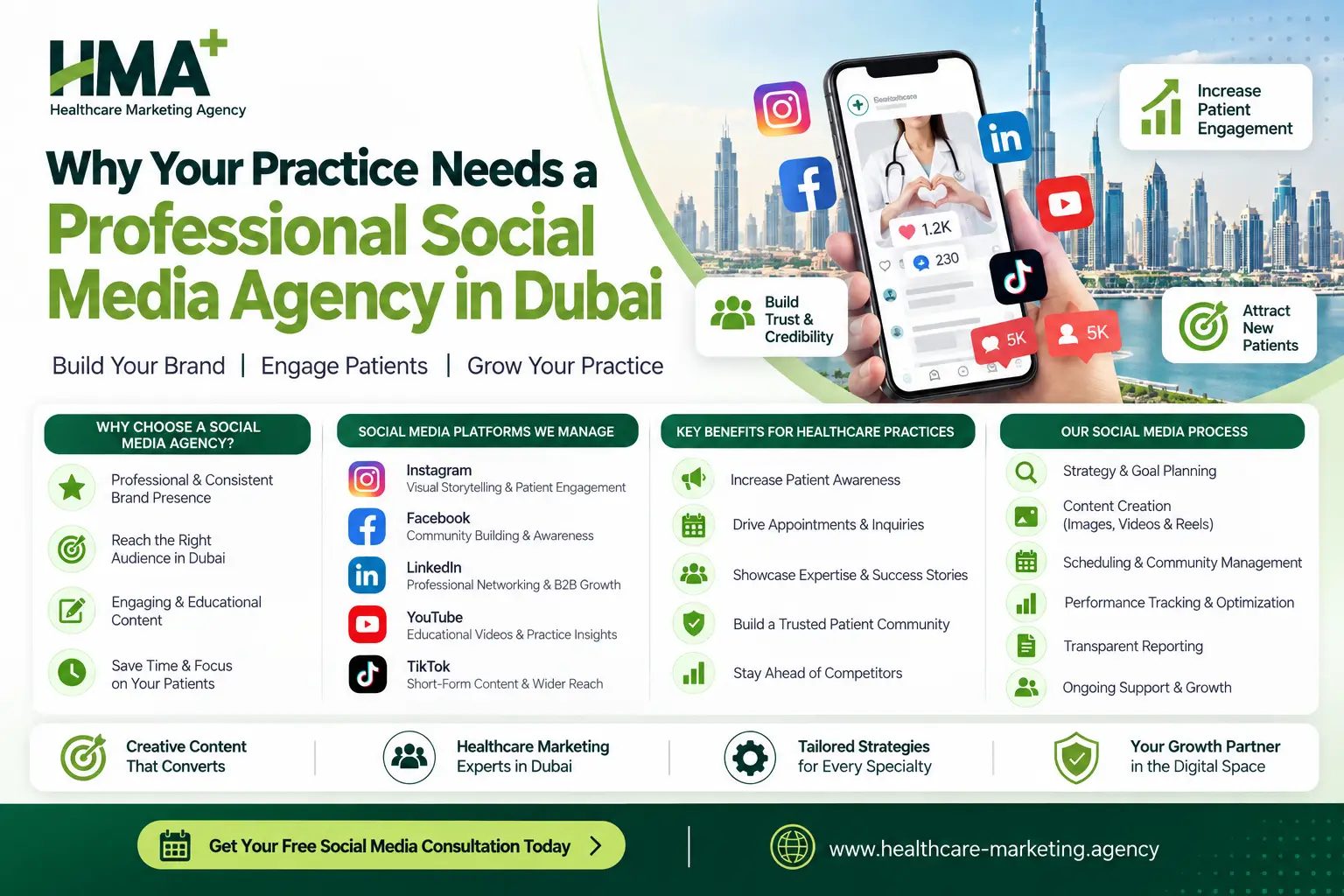
The real benefits of professional social media management
When social media is managed strategically by professionals who understand both healthcare and digital marketing, the impact extends beyond visibility. It supports stronger patient relationships, higher-quality enquiries, and a more credible online presence.
A professional social media strategy for a clinic in Dubai typically delivers:
- Content aligned with search intent: Posts and captions written to answer the questions patients are actually typing into Google and AI search tools.
- Reputation management: Monitoring reviews, responding appropriately, and addressing concerns before they affect perception.
- Multi-platform visibility: Presence optimized across Instagram, LinkedIn, YouTube, and emerging AI search tools like Gemini, Perplexity, and ChatGPT.
- DHA-compliant content frameworks: Every piece of content is reviewed against current UAE medical marketing regulations before publishing.
- Time returned to you: The most underrated benefit. Your bandwidth is better spent on patients, not content calendars.

Compliance and ethical communication in healthcare marketing
Dubai maintains strict standards for healthcare marketing, making compliance a key consideration for doctors and clinic owners. The challenge is staying visible while ensuring all communication remains accurate and ethical.
A compliant medical social media strategy should ensure:
- No misleading claims or exaggerated outcomes.
- Protection of patient privacy and confidentiality.
- Accurate representation of services and qualifications.
- A clear distinction between education and medical advice.
But compliance is about more than avoiding regulatory issues. It is the foundation of long-term patient trust. Patients are more likely to choose and remain loyal to providers whose content is honest, educational, and grounded in clinical reality.
The strongest healthcare marketing combines ethical communication with regulatory compliance, helping patients make informed decisions while protecting professional credibility.
How does HMA support doctors and clinics in Dubai?
HMA is a Dubai-based healthcare marketing agency built specifically for doctors, specialists, and private clinics operating in the UAE and broader GCC market.
Their team combines deep knowledge of DHA compliance frameworks with genuine expertise in digital strategy, including GEO-optimized content that performs on Google, AI answer engines, and local search.
Working with HMA means building a digital presence that attracts the right patients while maintaining the highest professional standards.
Key services include:
- DHA-compliant content production and review.
- Medical social media strategy tailored to Dubai’s multilingual, multicultural patient base.
- Generative Engine Optimization (GEO), so you’re visible to patients searching via ChatGPT, Gemini, and Perplexity.
- Reputation management and review strategy built for the Gulf market.
- Full-service clinic branding in Dubai that reflects the quality of care you deliver.
FAQ's
How does AI search optimization for healthcare change how patients find doctors?
AI search platforms increasingly generate answers from trusted, well-structured online content. Clear, evidence-based information across your website and social channels improves the likelihood of your expertise being surfaced to potential patients.
What is social media management for clinics in Dubai, and why is it important?
To improve patient experience, prioritize clear communication, empathy, and convenience. Streamline appointment scheduling, reduce wait times, and ensure staff are trained in patient-centered care. Leverage technology like telehealth and patient portals for accessibility. Actively seek feedback through surveys and use patient reviews to address concerns, fostering trust and satisfaction.
Can doctors manage social media themselves?
Yes, but maintaining a consistent strategy alongside clinical responsibilities can be difficult. Many clinics work with healthcare marketing specialists to ensure content remains professional, effective, and compliant.
Are there DHA guidelines for medical marketing on social media?
Yes. The DHA requires healthcare marketing to be accurate, ethical, and non-misleading. Clinics must avoid exaggerated claims and protect patient privacy.
Can an active social media strategy directly increase patient appointments?
Yes. Consistently publishing educational content, addressing patient concerns, and demonstrating expertise can strengthen trust and influence a patient’s decision when choosing between healthcare providers in Dubai.
Related Posts