

Performance Marketing in Healthcare: Google Ads vs Meta Ads for Better Patient Leads
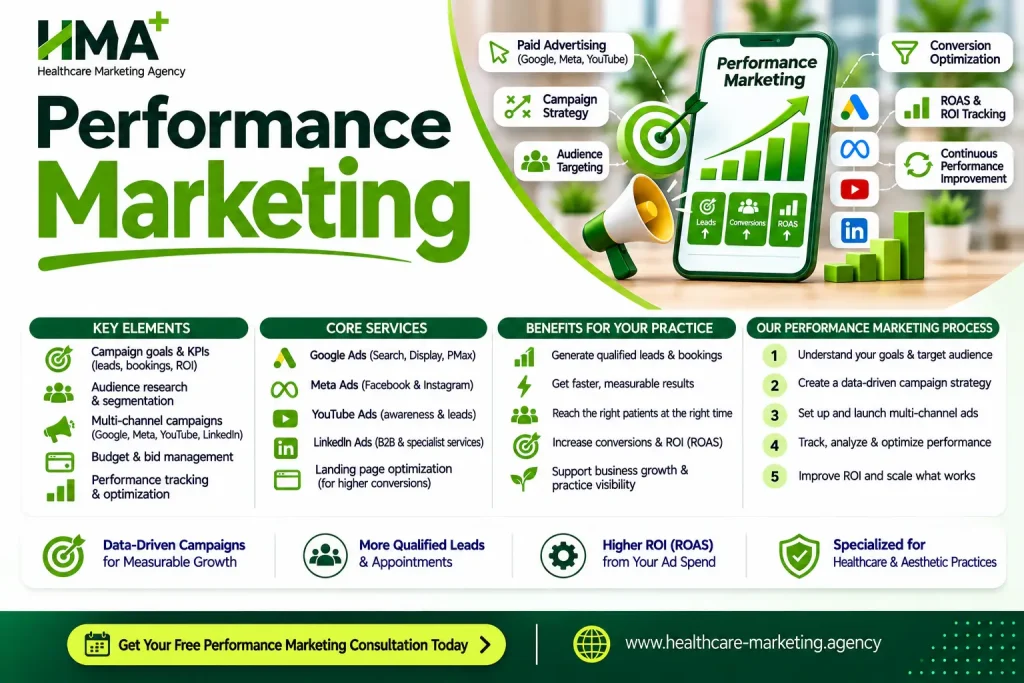
Performance marketing is when you pay for actions, such as a phone call or a WhatsApp message, based on a measurable action rate instead of paying for exposure. For a clinic, that makes Google Ads and Meta Ads two different tools: one answers patients who are already searching, and the other reaches people who have not started looking yet.
This guide compares both platforms for healthcare providers and explains what to track and how to choose a performance marketing agency.
What Is Performance Marketing in Healthcare?
What is performance marketing in practice? It is advertising where every campaign is judged by leads and patients, also called performance based marketing. A brand campaign counts views; this kind counts the calls and forms it produced. What does performance marketing include? Paid search, paid social, conversion tracking, landing pages and reporting that connects ad spend to booked consultations. Online performance marketing for clinics usually runs on Google Ads and Meta Ads.
Performance Marketing Strategy: Google Ads vs Meta Ads
Performance marketing strategy starts with understanding the user intent. A patient who is looking for a “dermatologist in Dubai” is ready to choose, and the ad can show a call button and the clinic’s address from its Google Business Profile. Someone scrolling Instagram is not, but a short video from a doctor can start the decision-making process, and a click-to-WhatsApp ad opens a chat with the clinic instead of a form.
Google Ads | Meta Ads | |
Patient intent | High: the search is the need | Lower: interest is created by the ad |
Main formats | Search ads with call and location assets, plus Performance Max | Reels and feed video, with Instant Forms or click-to-WhatsApp |
Best for | Treatments patients already search for | Awareness of new services and remarketing to site visitors |
Tracking | Conversion tags for calls and forms | Meta Pixel plus Conversions API |
Main risk | Paying for irrelevant searches without negative keywords | Cheap leads that never answer the phone |
Performance Marketing for a Clinic
Knowing how to do performance marketing starts with one conversion per service, such as a call or a WhatsApp click. Then each step builds on the last:
Break-down | What to do | Tool or setting |
1. Pick one conversion per service | Choose the action that counts as a lead for each treatment: a call, a form or a WhatsApp click. Set a minimum call length so short or wrong-number calls do not count. | Call tracking, form event, WhatsApp click event |
2. Install tracking before spending | Set up GA4 and the Google Ads conversion tag first. Then add the Meta Pixel with the Conversions API, which sends events from your server and recovers some that browsers block. Test every event before launch. | Google Tag Assistant, Meta Events Manager “Test Events” |
3. Launch Google Search first | Build one campaign per treatment and location, such as “rhinoplasty Dubai”. Add negative keywords for job seekers and free offers, and link the Google Business Profile so ads show the address and a call button. | Search campaigns, negative keyword list, call and location assets |
4. Send each campaign to a treatment page | Match the ad to a page about that treatment, with the doctor’s credentials, the form and a WhatsApp button. A homepage makes the patient search again. | One landing page per treatment |
5. Add Meta once tracking works | Remarket to site visitors with a short doctor video, and promote services patients do not yet search for. Use Instant Forms or click-to-WhatsApp, and qualify leads with one or two questions. | Meta remarketing audiences, Reels, Instant Forms, click-to-WhatsApp |
6. Add video for reach | Use YouTube video campaigns to introduce the doctor and the clinic to people who are not searching yet. Judge them by the leads and searches that follow, not views alone. | YouTube in-stream or Shorts campaigns |
A written performance marketing plan allows doctors and clinics to divide the budget by service and sets a target cost per qualified lead.
Weekly performance marketing management is key, raw data in itself is not valuable: read the search terms report and pause ads that spend without converting. On Meta, replace video creative that has gone stale.
A performance marketing expert will also time how fast the clinic answers each lead.
How to Measure Digital Marketing Performance

How to measure digital marketing performance starts with the funnel, from lead to patient, and each channel needs its own numbers:
Channel | What to track | Where to find it | What a weak result suggests |
Google Search | Conversion rate by keyword, cost per lead, search terms | Google Ads reports | Irrelevant searches, or a landing page that does not match the ad |
YouTube | View rate, cost per view, conversions that follow a view | Google Ads video reports | Many views but no leads: a weak creative or the wrong audience |
Meta Instant Forms | Cost per lead and the share of leads that answer the phone | Ads Manager plus your CRM | Cheap leads that do not answer: add a qualifying question |
Meta click-to-WhatsApp | Conversations started, cost per conversation, conversations that become patients | Ads Manager plus WhatsApp Business or CRM | Many chats but few patients: reply speed or the first message |
Meta Reels and video | ThruPlays and cost per ThruPlay | Ads Manager | Interest only: check whether site visits and leads follow |
Website | Key events by source and landing page conversion rate | GA4 | Traffic without actions: the page or the offer |
CRM | Lead-to-patient rate and patients by channel | Your CRM or booking system | A channel that brings leads but not patients |
Keep in mind how to measure social media marketing performance on Meta is different: Track cost per lead and the percentages of leads that become patients, split by ad and audience. A cheap lead that never answers is the most expensive one. Spanish-language reports call the same thing marketing digital performance, and the metrics do not change.
Performance Marketing Tips for Healthcare Ads
Read Google’s healthcare policy and Meta’s health and wellness policy before launch, because both restrict ad targeting by health condition (remarketing).
Avoid guarantees and before-and-after promises, and show the doctor explaining the treatment. Speed wins leads. A slow reply wastes the click.
Choosing a Performance Marketing Agency in Dubai
Providers comparing performance marketing companies should ask a performance marketing agency Dubai the same questions:
Question | What a good answer shows |
Have you run healthcare accounts? | Knowledge of ad policies and medical advertising rules |
What do you report? | Leads and patients, with clicks and impressions as context |
Who builds my campaigns? | A named specialist and a regular review call |
How is spend billed? | Management fee and ad budget kept separate |
Performance digital marketing only works when the agency can show how a lead became a patient. Requesting a consultation with HMA is a first step to planning Google Ads and Meta Ads around leads and patients.
FAQ'S on Performance Marketing in Healthcare
01What is generative engine optimization GEO in simple terms?
It is the work of getting your content quoted inside AI-written answers. Traditional SEO aims to rank you in a list of links. GEO aims to make you the source the answer is built from, which is a different outcome requiring a new AI-first SEO strategy.
02What's generative engine optimisation (GEO) going to cost me?
Less than most agencies would have you believe actually (a lot of it is editorial rather than technical). If your content is good then the amount of work involved in restructure and adding sources is minimal. A good gen engine optimisation agency will charge you for the technical set up and the ongoing measurement rather than for the writing.
03Is GEO replacing SEO?
No. Google still by far the biggest driver of traffic and conversions for the majority of businesses. GEO provides visibility within the answers that appear above the Google results. That’s what smart SEO looks like in 2026. SEO and AI visibility should be in one plan rather than two.
04Do I need generative engine optimisation services or can I do it myself?
A lot of it is entirely doable at home: clearer structure, cited sources, better author credentials. Gen engine optimisation services can help with crawler configuration, tracking citations across the various platforms and knowing which techniques have actually worked. The machine learning systems change so rapidly that what worked last quarter may well not work this quarter.
05Which generative engine optimization tools should I use?
Start with what you already have. Most SEO platforms now include AI visibility tracking. Dedicated generative engine optimization tools are worth adding once you are actively working on this and need per-platform detail, because visibility on ChatGPT and in Google AI Overviews rarely match.
06How does generative engine optimization work for a small business?
The same way, with a narrower focus. Pick the ten questions your customers ask most, answer each one properly on its own page, cite your sources, and get your business mentioned on the directories and local publications your industry uses. That is most of the work. If you are wondering what is generative SEO in practice, that is it, without the jargon.
07What Is Generative Engine Optimization GEO in SEO reporting terms?
Treat GEO in SEO reports as a separate line rather than a replacement metric. Report citations by platform alongside rankings, organic traffic and enquiries. GEO SEO reporting that shows only a visibility score tells you very little.
08How long does GEO take to show results?
Content restructuring often shows movement within 30-60 days. Building the brand mentions that drive citations takes three to six months. Neither is instant, and both compound.
09Can anyone guarantee I will appear in AI answers?
No. Nobody controls what a language model says, and outputs vary between sessions for the same question. Any agency promising placement is either misinformed or misleading you.