Email Marketing Campaigns for Clinics: Complete Guide 2026
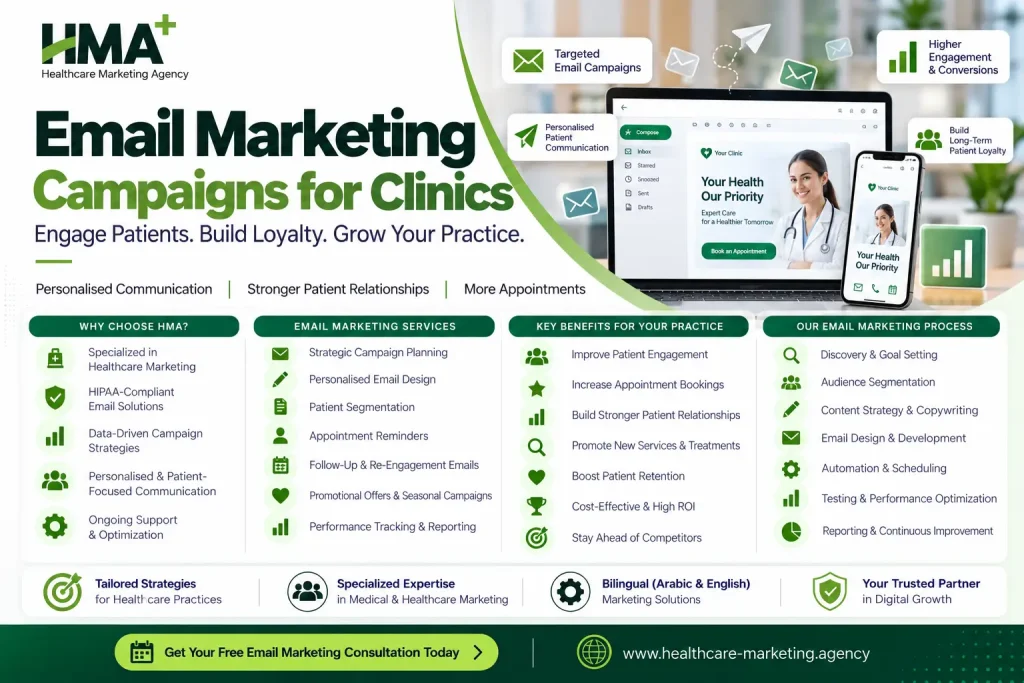
An expert guide for doctors, clinic managers, and healthcare decision-makers across the UAE.
Introduction: Why Are Your Clinic's Emails Not Bringing Patients Back?
Imagine a multispecialty clinic in Dubai that has invested years in building its reputation. It has experienced doctors, modern facilities, several medical departments, and a growing patient database. The marketing team sends monthly newsletters, announces new services, and occasionally promotes health packages.
Yet, when the clinic manager asks how many appointments these emails generated, nobody has a clear answer.
As a healthcare email marketing mentor at HMA, I see this as the central challenge clinics need to address. Email marketing is often treated as a way to distribute promotional messages rather than as a structured approach to patient communication. The focus remains on how many emails the clinic can send, instead of whether those messages are relevant, useful, and capable of supporting meaningful business outcomes.
For clinics across Dubai and the wider UAE, this represents a missed opportunity. Email marketing campaigns can help clinics communicate service information, share educational resources, maintain relationships with subscribers, and support appropriate appointment bookings. However, these outcomes depend on having the right strategy, audience, content, and measurement process in place.
In this guide, I will explain how I would approach email marketing for a multispecialty clinic, which problems deserve attention first, and how healthcare teams can build a more effective campaign strategy in 2026.
What Are Email Marketing Campaigns, and How Do They Work for Clinics?
I often find that the first step towards improving email marketing is changing how we define it.
An email marketing campaign is more than a newsletter or a promotional message sent to a database. It is a planned communication activity designed around a specific audience and objective. For a healthcare organisation, that objective could be educating subscribers about preventive healthcare, introducing a new department, increasing awareness of a service, or encouraging suitable patients to enquire about an appointment.
To understand how email marketing campaigns work, consider the different ways people interact with a clinic. Someone might discover the clinic through Google, subscribe to its newsletter, read educational content over several weeks, and eventually decide to book a consultation. Another person might already be a patient and simply need clear information about an upcoming appointment.
These people have different needs, so their communication should reflect those differences.
I also encourage clinics to understand the distinction between direct marketing and brand-building marketing. Direct marketing aims to encourage a specific action, such as enquiring about an available service. Brand-building marketing develops familiarity, credibility, and recognition over time. Email can support both objectives, provided the content is relevant and the communication is appropriate for the recipient.
The important point is that email should have a defined purpose. Without one, even a professionally designed campaign can become another message that patients ignore.
Why Traditional Email Marketing Campaigns Fail in Healthcare
The first problem I would investigate is whether the clinic sends the same email to everyone.
A multispecialty clinic might offer cardiology, dermatology, paediatrics, orthopaedics, gynaecology, and general medicine. Sending every subscriber a single newsletter covering every department may appear efficient, but it does not necessarily make the communication useful.
Someone interested in preventive heart health may not need information about an unrelated cosmetic treatment. A parent looking for paediatric services may have little interest in an orthopaedic promotion. When every message attempts to appeal to everyone, the clinic risks becoming irrelevant to individual readers.
The second problem is an excessive focus on promotions. If subscribers hear from a clinic only when it wants to advertise a package, they have little reason to engage with its next email. Useful educational information and clear explanations of available services give people a stronger reason to remain subscribed.
The third issue is measurement. Open rates and clicks can provide useful signals, but they do not automatically demonstrate that a campaign has generated appointments or revenue. A clinic needs to understand whether its emails contribute to qualified enquiries, completed bookings, attendance, or other defined objectives.
Healthcare also introduces an important responsibility: protecting personal information. Using patient data carelessly, sending unexpected health-related messages, or failing to respect communication preferences can damage trust and create compliance risks.
My recommendation is to address these problems before increasing email frequency. More emails will not fix an unclear strategy. Better targeting, more useful content, and meaningful measurement will provide a stronger foundation.

How to Improve Email Marketing Campaigns for UAE Clinics
When I assess an email marketing strategy, I start with the audience and the information available about it. Designing the next newsletter should come later.
Start With Relevant Audience Segmentation
The first improvement is to stop treating the patient database as one audience.
A clinic can organize subscribers according to appropriate factors such as language preference, expressed interests, communication preferences, and their relationship with the organization. The segmentation approach should reflect the purpose of the campaign and the permissions available.
For example, a general health newsletter could share preventive healthcare information with subscribers who have chosen to receive it. A separate campaign could introduce a new physiotherapy service to people who have expressed an interest in related services.
However, healthcare marketers must be careful when using information about diagnoses, treatment history, or medical conditions. Such information may be sensitive personal data, and its use for marketing requires particular scrutiny.
I would never recommend assuming that a patient’s medical record automatically gives the marketing team permission to send promotional emails. The organization must establish an appropriate lawful basis, respect the purpose for which information was collected, and implement suitable safeguards.
Segmentation is not about making an email appear personal for its own sake. It is about making communication more relevant, expected, and appropriate for the recipient.
Make Every Email Useful Before Making It Promotional
Once the audience is clear, the next question is what the email should actually communicate.
I recommend that clinics prioritize information that helps people understand their healthcare options. This might include general preventive health guidance reviewed by qualified clinicians, explanations of available services, introductions to medical departments, or practical information about preparing for a consultation.
Consider a multispecialty clinic introducing a new physiotherapy department. Rather than sending a short announcement that simply says the service is available, the clinic could explain the types of concerns physiotherapy may address, describe the assessment process, introduce the team, and provide a clear route for enquiries.
The promotional message becomes more useful because it answers questions readers may already have.
This is particularly important in healthcare, where trust is central to the relationship between a patient and a provider. Medical information should be accurate, appropriately qualified, and reviewed by the relevant clinical team. Claims about treatments and outcomes should never be exaggerated to increase clicks.
Use Automation to Improve Consistency
Automation can help clinics deliver communication more consistently without requiring the marketing team to manage every email manually.
A suitable system can automate subscription confirmations, newsletter delivery, and selected administrative workflows. For instance, someone who subscribes to a general health newsletter could receive a confirmation email followed by an introduction to the clinic and useful educational content.
However, I recommend keeping promotional automation separate from necessary appointment and care-related communication. A booking confirmation is not the same as a marketing campaign, and permission to receive one type of message should not automatically be treated as permission to receive the other.
Automation should improve consistency rather than remove human judgement. Communications involving treatment details, clinical advice, test results, or sensitive personal information require appropriate privacy and clinical safeguards.
Also Read – Arabic SEO services: How to increase Google traffic across the Middle East?
Types of Emails Every Multispecialty Clinic Should Consider
I would not advise every clinic to begin with a complicated email calendar. It is more practical to start with a few clearly defined communication types and understand the purpose of each one.
Appointment confirmations and reminders help patients keep track of scheduled visits. These are primarily operational communications and should contain only the information necessary for the task.
Educational emails help subscribers understand general health topics, preventive care, and available services. A clinic might publish a monthly newsletter featuring information reviewed by its medical team.
Service information emails explain a department, treatment, or facility. They are most useful when they answer genuine questions instead of making unsupported promises about results.
Re-engagement campaigns can invite appropriate, opted-in subscribers to explore relevant services or update their communication preferences. However, clinics should not assume that every inactive patient needs treatment or that a long gap between visits indicates a medical need.
Feedback requests can also help clinics understand the patient experience. These should encourage honest responses without pressuring patients to provide positive reviews.
Each type of email serves a different purpose. I would rather see a clinic execute a small number of relevant communications well than send frequent generic messages without a clear objective.
How to Create Email Marketing Campaigns That Patients Want to Read
Once the strategy is clear, writing the email becomes much easier.
I recommend starting every campaign by answering three questions: who is the intended audience, what information will be useful to them, and what should they do after reading the message?
The subject line should describe the value of the email without exaggeration. The opening paragraph should explain why information matters. The body should focus on one main idea, and the call to action should make the next step clear.
For example, an educational email from a multispecialty clinic could use the subject line, “A Practical Guide to Preparing for Your Health Check-Up.” The opening could explain how preparing questions and bringing relevant medical information can help patients make better use of their consultation. The email could then link to a clinic-approved preparation guide.
A service announcement might use the subject line, “Meet Our New Physiotherapy Team.” Its content could introduce the department, explain how enquiries are handled, and link to the relevant service page.
These examples of writing an email illustrate a principle I consider essential: the email should deliver the value promised by its subject line.
When deciding what are good emails to use for business, I focus on clarity, relevance, mobile readability, and a trustworthy sender’s identity. A recognizable clinic name, a monitored business email address, and a clear contact route are more useful than an unfamiliar sender name or a misleading subject line.
Clinics should also ensure that emails display properly on mobile devices, use accessible formatting, and include a clear way to manage marketing preferences or unsubscribe where required.
Email Campaign Management: Turning Individual Emails into a System
Good writing matters, but consistent execution matters just as much.
Email campaign management involves planning campaigns, maintaining contact records, checking permissions, preparing content, scheduling delivery, monitoring performance, and using the results to improve future communication.
I recommend starting with a simple monthly calendar. A clinic might publish one educational newsletter, communicate relevant service updates when appropriate, and maintain separate appointment communication workflows. The frequency should reflect the value of the content and subscriber preferences, rather than an arbitrary target for how many emails the team can send.
The clinic should also establish a review process. Marketing staff can prepare the campaign, while the relevant clinical team reviews medical content and appropriate privacy or compliance personnel to assess data use and promotional claims.
Deliverability deserves similar attention. The clinic should send emails from a properly configured domain, use suitable email authentication, remove invalid addresses, and honor unsubscribe requests. Purchasing email lists or repeatedly sending messages to unverified contacts is a poor foundation for a sustainable strategy.
Reporting should connect email activity to meaningful outcomes. Clicks and engagement are useful indicators, but qualified enquiries, completed bookings, attendance, and campaign-attributed revenue may provide a clearer picture of business value. Measurement should respect patient privacy and avoid exposing sensitive health information through analytics tools.
UAE-Specific Considerations: Privacy, Consent, and Healthcare Advertising
For clinics operating in Dubai and the wider UAE, compliance needs to be part of campaign planning from the beginning.
The UAE Personal Data Protection Law establishes requirements concerning personal data processing, subject to its scope and applicable exceptions. Healthcare providers must also consider the requirements that apply to their specific jurisdiction, licensing authority, and handling of health information. Certain free zones and healthcare jurisdictions may have additional or separate legal frameworks.
I would not treat a patient email address as a general marketing asset simply because the clinic has collected it. Clinics should document why contact information is collected, provide appropriate privacy information, manage communication preferences, and obtain the consent or other lawful basis required for the intended use.
Health information requires particular care. An email subject line that reveals a diagnosis or treatment could expose sensitive information on a shared screen or device. Appointment and care-related messages should avoid unnecessary clinical details and direct patients to appropriately protected channels when sensitive information needs to be accessed.
Promotional emails should also be reviewed against applicable healthcare advertising rules. Clinics should avoid unsupported guarantees, exaggerated treatment outcomes, and misleading claims intended to generate bookings.
I recommend that clinic management have its privacy and compliance arrangements reviewed by qualified advisers familiar with the relevant UAE jurisdiction. A general email marketing guide cannot replace that assessment.
How to Measure Whether Your Email Marketing Campaigns Are Working
I judge campaign performance by returning to the objective established at the beginning.
If the goal is to help subscribers discover a service, relevant clicks and qualified enquiries may be useful measures. If the goal is to support bookings, completed appointments can provide a stronger indicator when attribution is reliable. If the goal is to improve communication, responses, preference updates, complaints, and unsubscribe patterns can also offer valuable insight.
Open rates are useful as a directional measure, but privacy features and automated email loading can make them unreliable. A high open rate should not be treated as proof that a campaign has generated business.
Instead, I recommend establishing a baseline, running small tests where appropriate, and comparing results over time. A clinic could test two accurate subject lines for an educational newsletter or compare two versions of a service information page linked from an email.
The purpose is not to make every email perform better on every metric. It is to understand which communications serve the intended audience, and which ones support the clinic’s legitimate objectives.
Final Thoughts: A Better Approach to Email Marketing in 2026
I believe the most effective email marketing campaigns for clinics begin with a simple shift in mindset. Instead of asking how often the clinic should send emails, ask what information subscribers need, which communications they have agreed to receive, and how the clinic can make those communications genuinely useful.
For multispecialty clinics across the UAE, that means building relevant audience segments, creating educational content, using automation responsibly, protecting personal information, and measuring outcomes that matter.
Technology is important, but it cannot compensate for an unclear strategy. A clinic with a modest, well-managed email program can make better use of its communication than one that sends frequent promotional messages without a clear purpose.
If you are reviewing your clinic’s email strategy, I recommend beginning with your contact database, consent records, campaign objectives, and reporting process. Once those foundations are clear, it becomes easier to decide what to send, who should receive it, and how to measure its value.
Looking to improve email marketing for your clinic? Book a consultation with HMA to review your current approach and identify practical opportunities to improve patient communication, campaign management, and measurable marketing performance.
Related Posts