Arabic SEO services: How to increase Google traffic across the Middle East?
Key takeaways: Arabic SEO services at a glance
|
You may already have a strong English website. But if you serve patients, clients, or customers across the Middle East, many of them search in Arabic. If your pages don’t answer them in Arabic, you can lose visits you never knew you missed.
That’s where Arabic SEO services come in. This blog explains what they include, how they work, and how you can use them to grow Google traffic across the region. You’ll also see how to prepare your content for AI tools like ChatGPT, Gemini, Claude, and Perplexity.
What are Arabic SEO services?
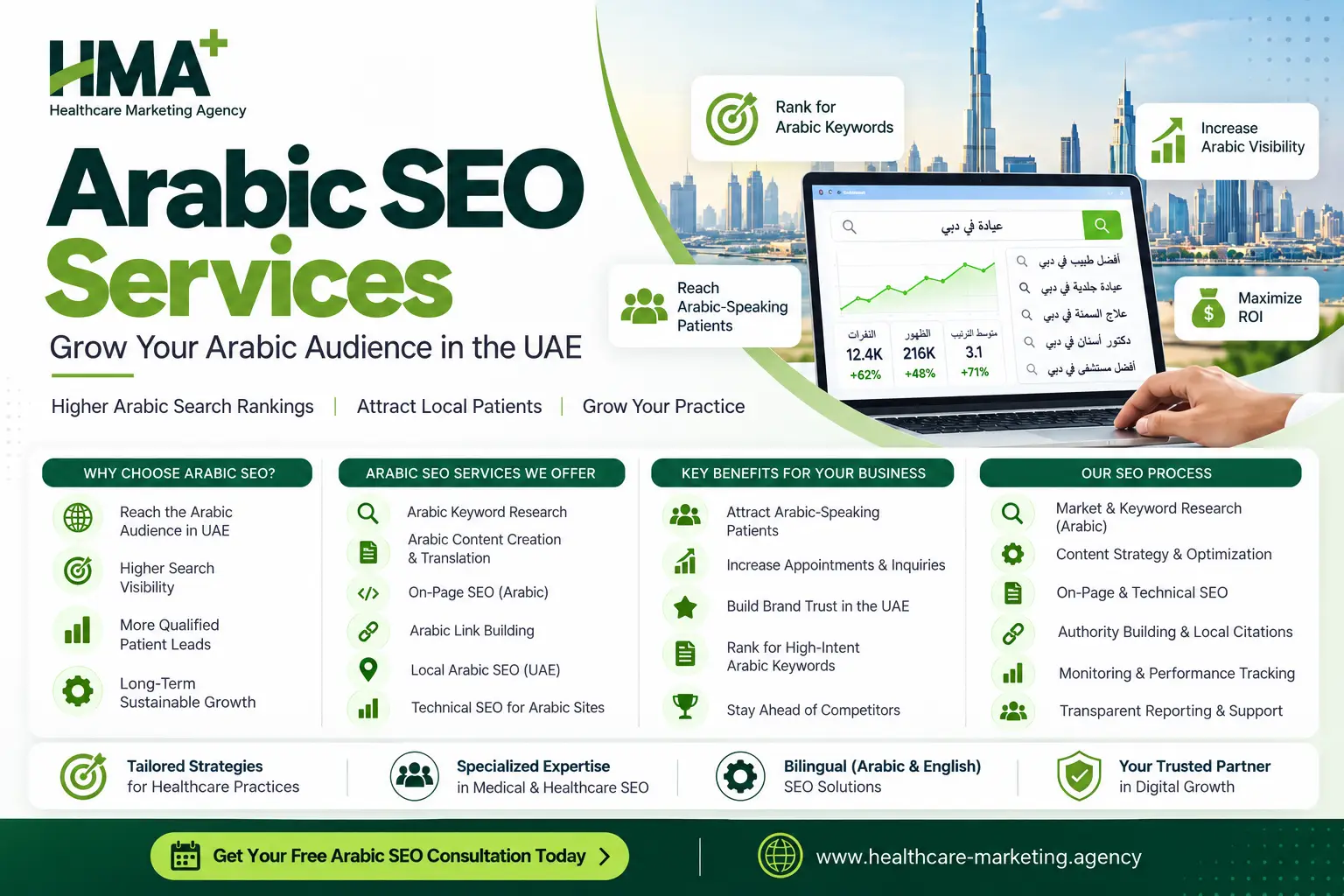
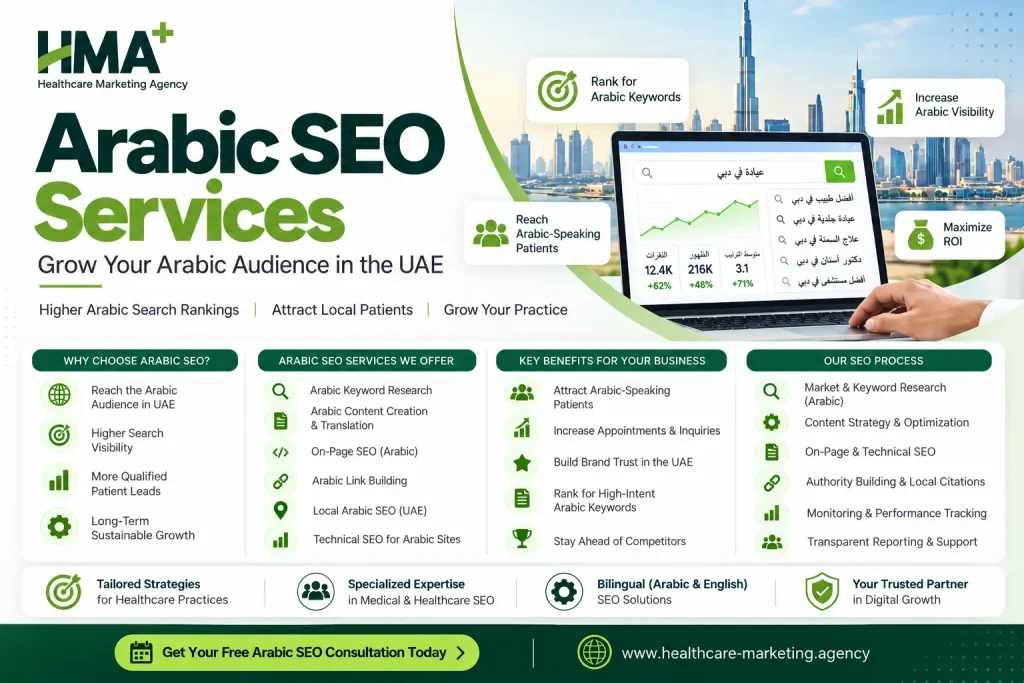
Arabic SEO services help your website appear in relevant Arabic search results. For healthcare businesses, this means making it easier for patients to find information about doctors, clinics, medical specialities, and treatments in Arabic.
It takes more than translating your English pages. You need to know how Arabic-speaking audiences search, the phrases they use, and the questions they ask before choosing a healthcare provider.
For example, a clinic in Dubai may have an English page about dermatology services. An Arabic-speaking visitor may search using a different phrase or ask a question about a specific skin concern. A well-planned Arabic SEO strategy helps the clinic create content that responds to those searches.
A complete Arabic SEO strategy may include:
- Arabic keyword research based on search intent
- Website copy written or reviewed by native Arabic speakers
- Arabic content creation and localization
- Technical SEO for Arabic and English pages
- Local SEO for clinics and hospitals
- Business listings and online review management
- Content optimization for Google Search and AI-powered search platforms
SEO Arabic goes beyond translating your website. It means using the right search terms and creating useful content that Arabic-speaking patients can understand and relate to.
Also Read – Pay Per Click Advertising Dubai: A Complete Guide for UAE Businesses
Why does your healthcare business need Arabic SEO across the Middle East?
Arabic speakers are a large online audience. Arabic content makes up a small share of the web compared with the number of people who speak the language.
For your healthcare business, the point is simple. When people look for a clinic, a service, or health information in Arabic, they want pages written for them.
Here’s what Arabic SEO services can do for you:
- Reach Arabic-speaking patients: Create content for people who prefer to search and read in Arabic.
- Improve service visibility: Make it easier for patients to find your specialities, treatments, doctors, and appointment details.
- Build patient confidence: Explain your services, doctors’ qualifications, and how to book an appointment in simple Arabic.
- Match real behavior: In the UAE, many people switch between Arabic and English during one search journey. Some types of Arabic words in Latin letters.
- Support your whole site: Arabic pages can sit next to your English pages and work together.
- Strengthen your digital presence: Connect Arabic SEO with English SEO, social media, and other relevant marketing activities.
SEO takes time to build visibility, and results depend on factors such as competition, website quality, and content. It cannot guarantee patient bookings, and healthcare decisions should always be based on individual needs and appropriate medical advice.
Arabic keyword research: Start with how people search
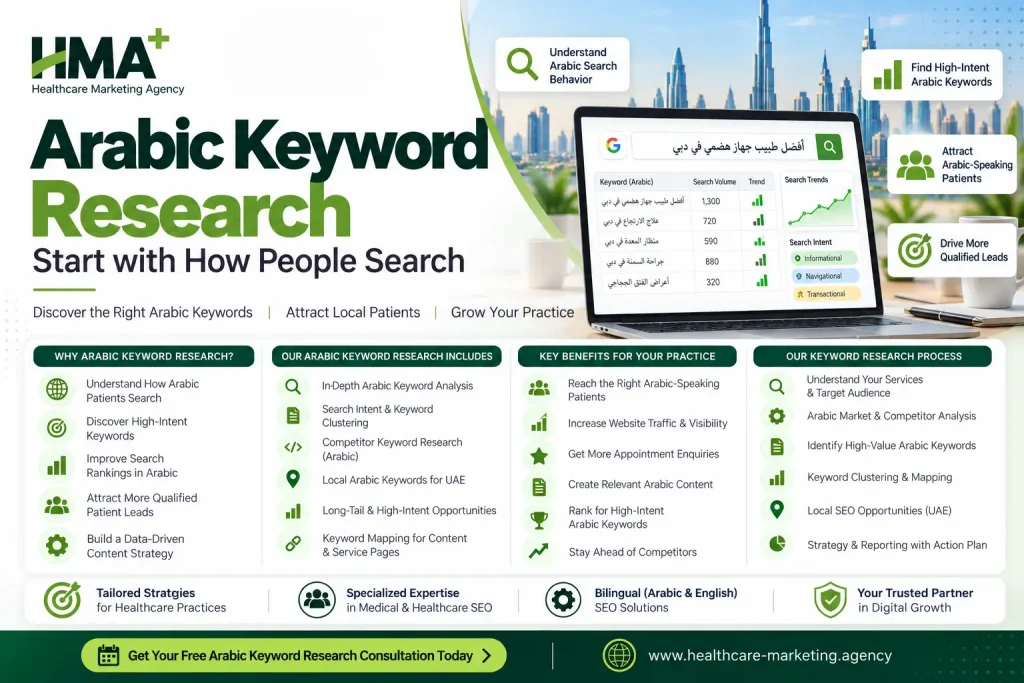
Arabic keyword research is the basis of every good plan. Don’t copy your English list and translate it word-for-word. Arabic has formal and spoken forms, and the Gulf region uses its own phrases.
Follow these steps:
- Identify your main services: List the medical specialities, treatments, diagnostic services, and locations you want to target.
- Research Arabic search terms: Explore how Arabic-speaking audiences describe these services, including common questions and alternative phrases.
- Use Google search suggestions: Check Google Autocomplete and “People also ask” results for relevant Arabic queries in your target market.
- Include spelling variations: Check Arabic searches, English terms, and Arabic words typed in Latin letters.
- Group keywords by intent: Separate searches for health information from those aimed at finding a clinic, contacting a provider, or booking an appointment.
- Match keywords to pages: Assign each keyword group to the right page to avoid overlap between pages targeting similar searches.
- Review search performance: Use Google Search Console and keyword tools to track clicks, impressions, and search queries.
- Update your keyword list: Remove irrelevant terms, identify content gaps, and adjust your targets based on search data and audience needs.
The keywords Arabic searchers use can vary by country. A phrase common in Saudi Arabia may sound different in the UAE. Test before you publish.
Creating Arabic content that reflects local search behavior
Good Arabic content starts with the reader, not the keyword. Google asks site owners to create helpful, people-first content. That means pages written to help someone, not just to rank.
Use these habits when you write:
- Hire native Arabic writers. Keep the language natural and easy to understand.
- Use local phrases. Check the Gulf Arabic wording with a local reviewer.
- Write question-style headings. People ask questions, and voice search follows the same pattern.
- Answer first. Put a short, clear answer right under each heading.
- Keep paragraphs short. Arabic text can run longer than English, so check your layout on a phone.
- Add a qualified reviewer. Have a licensed professional, such as a doctor, check health pages before you publish.
Follow DHA advertising rules. Avoid exaggerated claims, guarantees, and comparisons with other providers. Mention the risks whenever you describe a treatment.
Technical SEO for Arabic websites
Arabic websites need a technical setup that supports right-to-left (RTL) reading and helps search engines find and index the correct pages.
- Use separate URLs for each language version, such as /ar/ and /en/.
- Add hreflang tags so Google can match each page to the right language. Link every version to the others.
- Pick one canonical page if two URLs show similar content.
- Make the layout RTL-friendly. Menus, forms, buttons, and text should display correctly from right to left.
- Keep language switching simple. Visitors should be able to easily switch between the Arabic and English versions.
- Test the mobile experience. Check page speed, readability, navigation, and layout on smaller screens.
Addressing these technical requirements ensures that search engine crawlers interpret your Arabic pages accurately and deliver an optimal experience for site visitors across desktop and mobile devices.
Local SEO services in Dubai & Abu Dhabi
If you serve a city, local search matters. Google says local results rely mainly on three things: relevance, distance, and prominence.
Here’s how you can work on each one:
- Relevance: Fill in your Google Business Profile fully. Add your services, hours, and photos in Arabic and English.
- Distance: Make sure your address is accurate. You can’t change how far you are from the searcher.
- Prominence: Ask real patients or customers for honest reviews. Keep your name, address, and phone number the same across directories.
Local SEO services can also include location pages and Arabic content about your area. For Arabic SEO services Abu Dhabi and Dubai, build a separate page for each city. Add details that are true for that city. Don’t copy one page and swap the name.
Integrating GEO & AEO for Google AI overviews, ChatGPT, Gemini, & Perplexity
GEO (Generative Engine Optimization) and AEO (Answer Engine Optimisation) mean making your pages easy for AI tools to read and summarize. ChatGPT, Gemini, Claude, and Perplexity all pull from web pages. No one can promise that a tool will cite you. But you can make your content clear and trustworthy.
- Lead with the answer. Give a short, direct reply under each heading.
- Use question-based headings. Cover the questions patients are likely to ask.
- Add FAQ sections. Short answers are easy to pull into summaries.
- Name the author. Add a bio with real credentials where they apply.
- Cite trusted sources. Link to official guidance and research.
- Keep facts current. Update pages when rules or services change.
These changes can also support traditional SEO, helping your website serve both search engines and people looking for healthcare information.
Building E-E-A-T and search authority with HMA
E-E-A-T stands for experience, expertise, authoritativeness, and trust. Google uses it as a guide to judge whether content is helpful and reliable. It matters even more for health topics, because people act on what they read.
You can build it like this:
- Show who wrote and reviewed each page. Add names and credentials, such as Dr. [Name], where they apply.
- Share real experience. Explain how your team works and what patients can expect.
- Back-up claims. Link to recognized sources.
- Be open about limits. State risks and say that results vary.
- Keep your details consistent. Use the same name, address, and phone number everywhere.
HMA – Healthcare Marketing Agency, based in Dubai, supports healthcare providers with SEO and digital marketing. If you’re comparing an Arabic SEO agency, an Arabic SEO consultant in Dubai and Abu Dhabi, ask these questions first:
- Do native Arabic writers create the content?
- How do you handle Arabic keyword research?
- How do you set up hreflang and RTL?
- How do you follow DHA advertising rules?
- Can you show a sample report?
Be careful with anyone who promises a fixed rank or a set date. Search results change, and many factors sit outside anyone’s control.
Grow your Middle East audience with Arabic SEO services Dubai & Abu Dhabi
Reaching more people across the Gulf region takes more than translating your website into Arabic. You need an SEO strategy that reflects local search behavior, language differences, and healthcare advertising requirements.
HMA helps healthcare businesses build their online presence through a strategy that considers:
- Healthcare expertise: Content planning that accounts for the need for accurate medical information and appropriate clinical review.
- Compliance awareness: Content developed with applicable DHA healthcare advertising requirements in mind, avoiding exaggerated claims and promises of specific results.
- Bilingual SEO planning: Separate Arabic and English keyword research based on how people search in each language.
- Clear reporting: Regular updates on organic traffic, keyword visibility, and areas that may need improvement.
- Realistic expectations: An approach that recognizes SEO takes time and that results depend on competition, website quality, and other factors.
If you want to improve your healthcare website’s visibility in the UAE, explore Arabic SEO services in Dubai and Abu Dhabi with HMA. Contact the team to discuss your goals and the right approach for your practice.
FAQ's on arabic seo services
Why do I need Arabic SEO services if my English site ranks well?
Arabic and English searchers often use different words. An English page may not appear when someone searches in Arabic.
What is the difference between Arabic SEO and local SEO?
Arabic SEO targets Arabic searches, while local SEO improves visibility in location-based searches. Combining both can help clinics reach local Arabic-speaking audiences.
How do you conduct Arabic keyword research?
Arabic keyword research identifies relevant search terms by analyzing search intent, regional language differences, Google suggestions, and keyword data.
Are there DHA guidelines for medical marketing on social media?
It depends on your needs. A consultant can guide strategy. An agency can also handle writing, technical work, and reporting.
How long does Arabic SEO take to show results?
Results vary by competition, website quality, and SEO work. Improvements may take several months, and specific rankings cannot be guaranteed.
Does healthcare content need special care in SEO Arabic?
Yes. Healthcare content should follow DHA advertising rules, avoid misleading claims or guarantees, and be reviewed by a qualified medical professional before publication.
Related Posts