Is Your Clinic Invisible to AI-first Patients? Reclaiming Your Practice’s Visibility in the Age of AI Search
Many Dubai clinics are noticing a drop in website traffic despite their top search rankings. Google’s new AI Overviews are now providing direct answers at the very top of the results page. If your practice is not cited in these summaries, you are likely becoming invisible to your patients.
The Rising Tide of Zero-Click Search
The era of the traditional blue link is quickly fading for many healthcare searches. Patients now find the information they need without ever clicking through to a clinic’s website.
“AI is not just a new feature; it is a new gatekeeper. If you are not providing the answer the gatekeeper wants in the format it requires, you are essentially locked out of the conversation,” says search strategist Eli Schwartz.
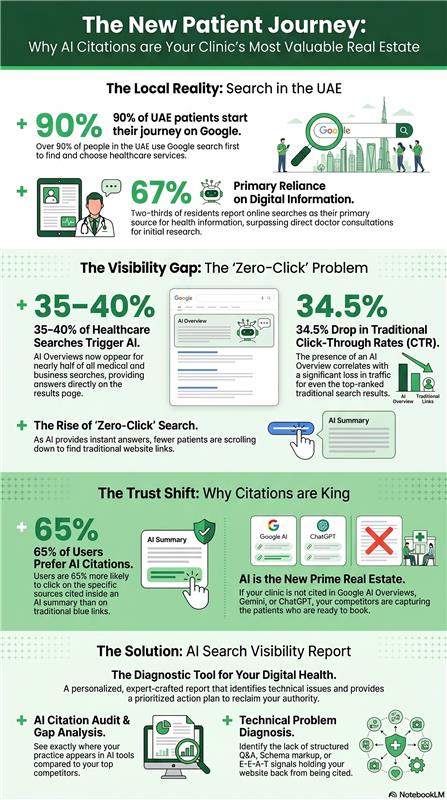
Statistics show that around 35 to 40% of searches in healthcare now trigger these AI summaries.
This shift has led to a major rise in what experts call zero-click searches. A recent analysis found that the presence of an AI Overview correlated with a 34.5% lower click-through rate for top organic results.
About 65% of users say they are more likely to click on sources that appear inside these AI summaries compared to scrolling through links.
If your clinic is not cited, you are losing that prime visibility to your local competitors.
To be recognized by these systems, your digital presence must show expertise, experience, authority, and trust. AI tools are designed to be risk-averse and will only cite sources they find highly credible.
“The future of SEO is not just about rankings, but about becoming the most trusted entity in your niche,” notes industry expert Neil Patel.
Many medical websites fail to appear because their content is not optimized for snippet extraction. AI systems prefer concise, clear answers in formats like lists, statistics, and clear definitions.
A lack of technical schema markup also makes it difficult for AI to understand your clinical context. Without FAQ or local business schema, your website might be ignored by systems like Gemini or ChatGPT.
Improving visibility is only part of the battle for clinical growth. Once a patient clicks your citation, they need to find a seamless and high-trust environment.
Bridge the Trust Gap to Win More Patients
High friction on a website is one of the most common reasons patients fail to book an appointment. Issues like slow mobile load speeds or tiny booking buttons can drive potential patients away.
“Don’t make your users think,” famously stated UX specialist Steve Krug. In healthcare, a patient seeking care is often stressed and needs a frictionless path to help.
Understanding why your practice is being ignored by these new tools requires a specialized diagnostic approach. The AI Search Visibility Report provides a manual audit to see exactly where your clinic appears in AI tools like ChatGPT and Google.
This report identifies the specific technical issues and backlink gaps that are holding your website back from being cited. By comparing your data to close competitors, you can see exactly where to focus your optimization efforts.
To ensure that your new visibility actually leads to appointments, you must evaluate the entire patient journey. A Website x Patient Fit UX Report identifies the specific friction points that are currently costing you patients.
This report analyzes trust signals and mobile usability to help you turn more of your existing traffic into bookings. Implementing these specific, fixable actions helps transform your website into a premium platform for your clinical practice.
Securing Your Future in Healthcare Search
Google is moving toward an AI-first search results page, and your medical practice must act now. By optimizing for citations and improving your website experience, you can stay ahead of the competition. Focus on being more than just present; aim to be the most prominent and trusted voice for your patients in Dubai.