What Is a Content Roadmap? A Guide to Planning an Effective Content Strategy for 2026
Content marketing has changed considerably over the last few years. What once revolved around publishing blogs, sharing social media posts and producing occasional videos has evolved into a much broader discipline. In 2026, content exists in multiple formats, across several platforms and at different stages of the customer journey. From short-form Instagram videos and LinkedIn thought leadership to long-form educational articles, email newsletters, interactive resources and personalised campaigns, every piece of content has a role to play.
But there is another challenge. Audiences are increasingly exposed to promotional messages from brands competing for their attention. Patients scroll past advertisements, encounter similar treatment offers and receive countless marketing messages every day. Simply publishing more content or increasing advertising frequency does not necessarily make a clinic more memorable.
For doctors and clinic managers in the UAE, particularly in Dubai’s competitive healthcare market, this creates an important question: how do you create content that attracts attention, establishes credibility and ultimately encourages patients to visit your clinic?
The answer begins with a well-planned content roadmap.
What Is a Content Roadmap?
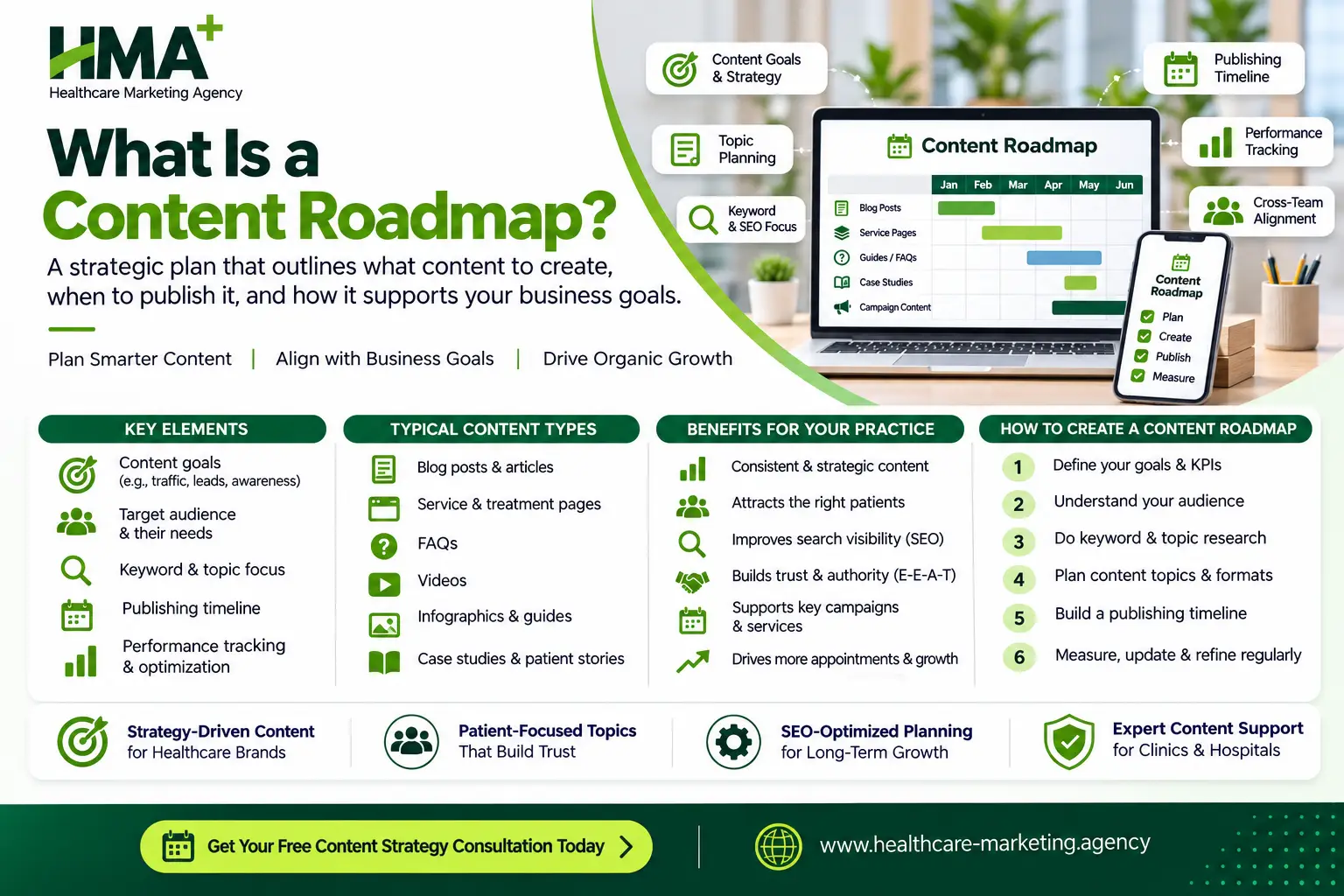
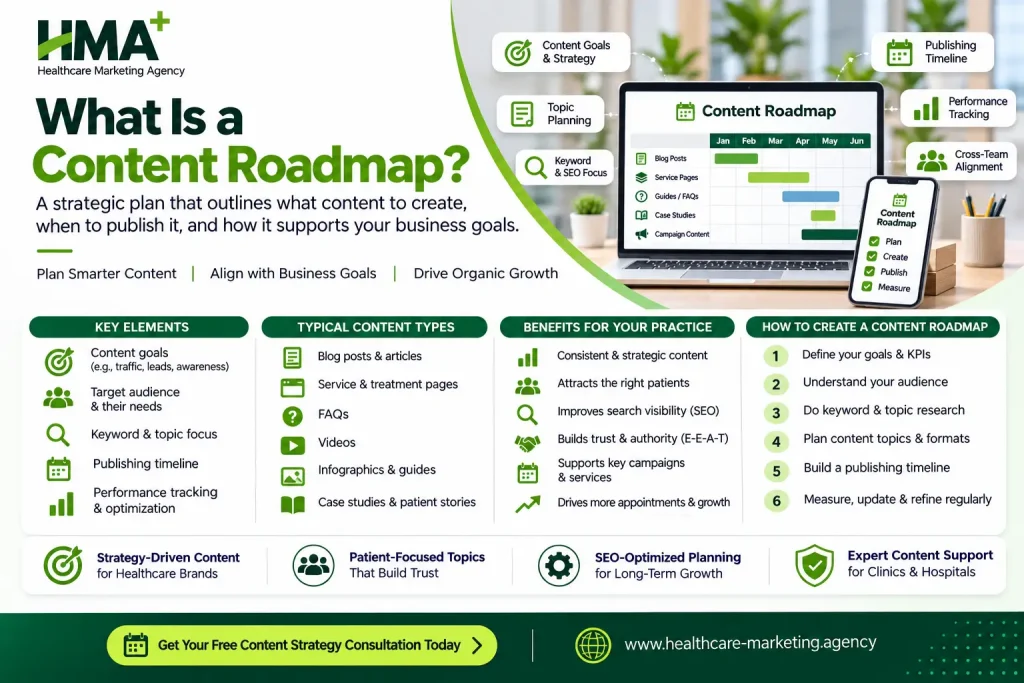
A content roadmap is a strategic plan that defines what content a business should create, who it should reach, where it should be distributed, when it should be published and what business objectives it should support.
Unlike a basic publishing schedule, a roadmap connects individual content initiatives to a larger marketing strategy. It considers audience interests, business priorities, platform requirements, available resources and measurable outcomes.
To understand the distinction, consider these three related concepts:
- Content strategy: Defines why you are creating content, who you are creating it for and what you want to achieve.
- Content roadmap: Establishes what needs to be created, which formats and channels to prioritise, and how different initiatives fit together over time.
- Content calendar: Specifies the actual publication dates, topics, responsibilities and deadlines.
For a healthcare organisation, the roadmap might include a six-month plan covering educational blogs, treatment-specific landing pages, doctor-led videos, Instagram campaigns, patient newsletters and local SEO initiatives.
Each initiative serves a different purpose, but all contribute towards the same objective: helping prospective patients understand your services, build confidence in your medical expertise and take the next step towards booking a consultation.
Why Content Strategy Matters More in 2026

Understanding what is a content strategy today requires looking beyond the traditional relationship between content and social media engagement.
Patients no longer rely on a single source of information when choosing a healthcare provider. They may discover a clinic through Google, watch a doctor’s Instagram videos, explore treatment information on its website, read reviews and compare available services before making an appointment.
Every interaction contributes to their perception of the clinic.
This is where content becomes a long-term business asset. An informative article can improve search visibility, a doctor’s educational video can establish familiarity, and a carefully designed newsletter can encourage an existing patient to explore another relevant service.
There are three major reasons why clinics need a more structured approach in 2026.
- Patients are becoming more selective about the content they consume.
With brands constantly promoting products, services and offers, audiences have become more accustomed to ignoring generic marketing messages. Patients are more likely to engage with information that addresses their concerns, answers their questions and helps them make informed healthcare decisions.
- Content consumption is increasingly platform-specific.
A person browsing Instagram has different expectations from someone reading a detailed article on Google or following a medical professional on LinkedIn. Reusing exactly the same content everywhere can undermine its effectiveness.
- Trust has become central to patient acquisition.
Healthcare decisions involve personal concerns, expectations and perceived risks. Patients need confidence in a doctor’s qualifications, experience, communication and approach to care. Content can help establish that confidence before the first consultation.
This is how content marketing is changing the game: instead of treating every interaction as an opportunity to sell a treatment, clinics can use content to build relationships that eventually translate into enquiries, consultations and patient visits.
The Different Pillars of Content Marketing in 2026
An effective content strategy should not depend on one format or distribution channel. Clinics need to develop a combination of content initiatives that serve different audience needs.
- Long-form educational content
Long-form content includes blogs, detailed service pages, treatment guides, frequently asked questions and educational resources.
For example, a dermatology clinic in Dubai could publish an in-depth guide explaining the differences between common acne treatments, their suitability, potential considerations and when patients should consult a dermatologist.
This type of content helps clinics address specific search queries, build topical authority and provide information that prospective patients can revisit when making healthcare decisions.
It also creates opportunities for search engine optimisation (SEO) and visibility across AI-powered search experiences.
- Short-form video and social media content
Short-form videos have become an important way for healthcare professionals to communicate complex information in an accessible format.
Instagram Reels, YouTube Shorts and other short-video formats can be used for doctor introductions, procedure explainers, common patient questions, clinic walkthroughs and general health education.
However, the objective should not simply be to follow trending audio or maximise views. A clinic should develop recognisable content themes that reflect its specialities, medical expertise and patient concerns.
- Platform-specific content
A common mistake is treating every social media platform as another place to distribute identical posts.
A more effective approach considers the audience and purpose of each platform.
For example:
- Instagram: Visual education, short-form videos, doctor introductions, clinic experiences and treatment information.
- LinkedIn: Professional insights, medical leadership, healthcare industry developments and clinic credibility.
- YouTube: Longer educational videos, detailed treatment explanations and discussions with healthcare professionals.
- Google and the clinic website: Search-focused educational articles, service pages and location-specific information.
The same subject can be repurposed across these channels, but the presentation, language and format should be adapted to the platform.
- Email newsletters and patient nurturing
Content marketing does not stop when someone visits your website or follows your social media account.
Email newsletters offer an additional channel for maintaining communication with existing subscribers and patients who have consented to receive relevant updates.
A clinic might share seasonal health information, educational newsletters, new service announcements, appointment reminders or relevant promotional offers and coupons where permitted, forming a holistic patient nurturing system of their own.
The important distinction is that newsletters should provide value rather than become another source of repetitive sales messaging. Communications must also respect patient privacy and applicable marketing consent requirements.
- Doctor-led and credibility-building content
In healthcare, the expertise behind a clinic is often as important as the services it provides.
Doctor-led content helps introduce the professionals responsible for patient care. This could include educational discussions, clinical perspectives, explanations of treatment approaches and answers to common questions.
Similarly, patient stories and testimonials may help communicate experiences, subject to appropriate consent, applicable advertising rules and careful presentation that does not imply guaranteed results.
The objective is to demonstrate credibility through useful and responsible communication, not exaggerated promises.
- Search and AI-focused content
Patients increasingly use AI-powered tools and search experiences to explore health questions and compare healthcare providers.
Clinics should therefore create clear, accurate and well-structured information that answers relevant questions and demonstrates genuine medical expertise.
This includes comprehensive service pages, doctor profiles, educational articles, local information and frequently asked questions.
Content should be developed primarily for people seeking reliable healthcare information, with search and AI discoverability considered as part of the distribution strategy.
How to Build an Effective Content Roadmap for Your Clinic

Understanding the different content formats is only the beginning. The real challenge is connecting them into a coordinated strategy.
Here is a practical framework doctors and clinic managers can follow.
Step 1: Define your business and patient acquisition objectives
Start by identifying what the clinic wants its content marketing to achieve.
Is the priority to generate more consultations for a particular speciality, increase awareness in a specific Dubai neighbourhood, introduce a new treatment or improve the clinic’s online reputation?
The objectives should be specific enough to guide content decisions.
For example, a dental clinic looking to increase implant consultations should prioritise content addressing implant suitability, treatment stages, frequently asked questions, recovery considerations and the qualifications of its dental specialists.
Step 2: Understand your target patients
Before deciding what to publish, understand who you want to reach.
Consider their age groups, locations, healthcare concerns, treatment interests, search behaviour and common barriers to booking an appointment.
For clinics in Dubai, this may also involve considering the diverse nationalities, languages and expectations of the local patient population.
Patient research should inform both the topics you select and the way you communicate them.
Step 3: Audit existing content and identify gaps
Review your website, social media profiles, existing blogs, videos, newsletters and other marketing materials.
Identify which content attracts meaningful engagement, generates enquiries and addresses patient questions.
Look at competitor clinics as well. What subjects are they discussing? Which formats are they using? Are there important patient questions that remain unanswered?
An audit helps prevent unnecessary duplication and identifies opportunities for developing more useful content.
Step 4: Create content pillars and map them to patient journeys
Organise your content into a few strategic themes.
For example, an aesthetic clinic might develop pillars around skin education, treatment awareness, doctor expertise, patient FAQs and clinic services.
Next, connect these themes to the patient journey:
- Awareness: Educational content that helps people recognise a concern or understand a treatment.
- Consideration: Detailed explanations, doctor-led videos and comparisons that help people evaluate their options.
- Decision: Service information, consultation guidance, clinic location, doctor credentials and clear appointment pathways.
- Retention: Relevant newsletters, follow-up education and ongoing patient communication.
This ensures your content does not focus exclusively on attracting new audiences while ignoring people who are already considering a consultation.
Step 5: Select formats, platforms and publishing frequency
Decide which formats best communicate each topic and where they should appear.
A single subject, such as a treatment guide, could become a detailed website article, several short educational videos, an Instagram carousel and a newsletter feature.
This approach makes content production more efficient while maintaining consistency across channels.
Build a realistic publishing schedule based on available resources, rather than committing to a volume that the clinic cannot sustain.
Step 6: Measure performance and refine the roadmap
Content performance should be evaluated against the original business objectives.
Track relevant indicators such as organic traffic, search visibility, video engagement, qualified enquiries, appointment bookings and conversions from content-led campaigns.
For clinics, the most important question is not simply how many people viewed a post. It is whether the content helped the right patients discover the clinic and take meaningful action.
Review results regularly and adjust the roadmap based on what patients respond to.
How AI Agents Are Transforming Content Marketing
AI has introduced another dimension to content planning and execution.
When discussing how AI agents transform content marketing, it is important to distinguish between using AI to generate individual posts and using AI-powered workflows to support an entire content operation.
AI agents can assist with analysing search trends, identifying audience questions, researching content opportunities, organising topic clusters, repurposing existing material and analysing campaign performance.
For example, an AI-supported workflow could identify frequently searched questions about a clinic’s speciality, suggest educational topics, prepare initial content briefs and organise them into a publishing roadmap.
However, automation should not replace medical expertise or strategic judgement. Healthcare content still requires clinical review, accurate information, appropriate context and compliance checks before publication.
Tools such as the advanced content roadmap generator can also help structure content initiatives, organise timelines and bring different marketing activities into one planning framework.
The real opportunity is to use AI to improve efficiency while allowing healthcare professionals and marketing specialists to focus on accuracy, creativity and patient needs.
Does Content Marketing Work for Healthcare Clinics?
Yes, provided it is approached as a long-term patient acquisition and relationship-building strategy rather than an isolated publishing activity.
Content marketing may not generate immediate walk-ins from every article or social media post. Its value comes from the combined effect of visibility, education, credibility and consistent communication across multiple patient touchpoints.
A well-planned strategy can help a clinic attract relevant search traffic, answer patient questions, build familiarity with its doctors and make its services easier to understand.
However, content alone cannot guarantee appointments. Website experience, local search visibility, reputation, appointment availability, enquiry handling and the quality of patient communication all influence whether interest becomes an actual visit.
The goal is to make every content initiative contribute to a connected patient acquisition process.
Build a Patient-Focused Content Strategy with HMA
Creating content consistently is challenging. Creating content that supports a clinic’s reputation, communicates medical expertise and generates meaningful patient enquiries requires an even deeper understanding of healthcare marketing.
This is where having the right strategic partner makes a difference.
At HMA, we understand that healthcare content marketing requires more than publishing attractive social media posts or producing generic articles. It requires a structured understanding of your specialities, target patients, competitive environment and business objectives.
As a healthcare marketing agency in Dubai, we help doctors, clinics and hospitals develop content marketing strategies that connect educational communication with measurable marketing goals.
Our content marketing services can support your clinic through content strategy development, SEO-focused blogs, social media content planning, doctor-led video concepts, website content, email marketing and coordinated content distribution.
More importantly, we focus on building a content roadmap around your patients: what they want to know, what influences their healthcare decisions and what encourages them to take the next step towards your clinic.
Whether you are launching a new speciality, looking to strengthen your online presence or struggling to convert digital visibility into patient enquiries, the right content strategy can help create a more consistent foundation for growth.
Ready to build a content strategy that brings your clinic closer to the patients you want to reach?
Enquire about HMA’s content marketing services and let our healthcare marketing specialists help you develop a patient-focused content roadmap for 2026 and beyond.
FAQ's on what is a content roadmap
1. What is a content roadmap?
A content roadmap is a strategic plan that defines what content your clinic will create, who it is meant for, where it will be published and when, and which business goal each piece supports. For a clinic, that might mean a six-month plan covering educational blogs, treatment pages, doctor-led videos, Instagram campaigns and patient newsletters. Instead of publishing randomly, every piece has a purpose, such as helping prospective patients understand your services and book a consultation.
2. How is a content roadmap different from a content calendar?
The roadmap is the big-picture plan. It sets priorities, themes, formats and channels over several months, and ties them to goals like more consultations for a speciality. The content calendar is the day-to-day schedule that comes from it, with publication dates, topics, owners and deadlines. A calendar without a roadmap can turn into a publishing treadmill, with regular posts but no direction. Clinics need both, with the roadmap created first.
3. Is a content roadmap the same as a content strategy?
No, though they work together. Your content strategy explains why you are creating content, who your target patients are and what you want to achieve. The roadmap turns that direction into a practical plan, deciding which formats and channels to prioritise and how the initiatives fit together over time. Put simply, the strategy is the “why”, the roadmap is the “what and how”, and the calendar is the “when”.
4. How long should a clinic’s content roadmap cover, and how often should it be updated?
Most clinics do well planning six to twelve months ahead. That is long enough to build momentum with SEO, video and newsletters, but short enough to stay realistic. Review the roadmap every quarter against your results. Small week-to-week changes belong in the content calendar, while the quarterly review is the time to change priorities. Patient interests, new treatments, seasonal demand and search trends all shift, so a plan that is never revisited quickly goes stale.
5. How does a content roadmap help with AI search visibility?
Patients increasingly use AI-powered tools and search experiences to explore health questions and compare clinics. A roadmap helps you plan the content these tools rely on: clear service pages, doctor profiles, educational articles, location information and frequently asked questions. Planning these in advance ensures your content is accurate, well structured and covers the questions patients ask, so you are more likely to be understood and cited. All of this content should be reviewed by qualified medical professionals before publication.
6. How do you measure whether your content roadmap is working?
Measure results against the goals you set at the start, not just surface numbers like views or likes. Useful indicators for clinics include organic traffic, search visibility, video engagement, qualified enquiries, booked consultations and conversions from content-led campaigns. The key question is whether your content helped the right patients find your clinic and take action. Review these figures regularly and use them to decide which topics and formats to repeat, improve or drop.
Related Posts